How Did the Arts of the West African Empires
The Ghana Empire
The Ghana Empire was located in what is now southeastern Mauritania, western Mali, and eastern Senegal, and derived its power from the control of trans-Saharan trade, particularly gold trade.
Learning Objectives
Draw the Ghana Empire and the source of its wealth
Key Takeaways
Key Points
- The Republic of ghana Empire, chosen the Wagadou (or Wagadu) Empire by its rulers, was located in what is now southeastern Mauritania, western Mali, and eastern Senegal. There is no consensus on when precisely information technology originated. Different traditions identify its ancestry between as early every bit 100 CE and the ninth century, with most scholars accepting the 8th or 9th century.
- Ghana'south economic development and eventual wealth was linked to the growth of regular and intensified trans-Saharan trade in aureate, table salt, and ivory, which immune for the development of larger urban centers and encouraged territorial expansion to gain control over unlike merchandise routes.
- The empire'south capital is believed to have been at Koumbi Saleh on the rim of the Sahara desert. Co-ordinate to the clarification of the boondocks left by Al-Bakri in 1067/1068, the capital was really two cities, but "betwixt these two towns are continuous habitations," and then they might have merged into i.
- The Ghana Empire lay in the Sahel region to the northward of the West African gilt fields, and was able to turn a profit by controlling the trans-Saharan golden trade, which turned Ghana into an empire of legendary wealth.
- Ghana appears to take had a central core region and was surrounded past vassal states. I of the earliest sources notes that "under the king's authority are a number of kings." These "kings" were presumably the rulers of the territorial units often calledkafu in Mandinka.
- Although scholars contend how and when Republic of ghana declined and collapsed, it is articulate that it was incorporated into the Republic of mali Empire around 1240.
Key Terms
- the Almoravids: A Berber imperial dynasty of Morocco that formed an empire in the 11th century that stretched over the western Maghreb and Al-Andalus. Founded by Abdallah ibn Yasin, their capital was Marrakesh, a metropolis they founded in 1062. The dynasty originated among the Lamtuna and the Gudala, nomadic Berber tribes of the Sahara, traversing the territory between the Draa, the Niger, and the Senegal rivers.
- the Soninke people: A Mandé people who descend from the Bafour and are closely related to the Imraguen of Mauritania. They were the founders of the ancient empire of Ghana c. 750–1240 CE. Subgroups include the Maraka and Wangara.
- Koumbi Saleh: The site of a ruined medieval town in southeast Mauritania that may have been the capital of the Ghana Empire.
Disputed Origins of the Ghana Empire
The Republic of ghana Empire, called the Wagadou (or Wagadu) Empire by its rulers, was located in what is now southeastern Mauritania, western Mali, and eastern Senegal. There is no consensus on when precisely information technology originated, but its development is linked to the changes in trade that emerged throughout the centuries after the introduction of the camel to the western Sahara (3rd century). By the fourth dimension of the Muslim conquest of N Africa in the 7th century, the camel had inverse the earlier, more irregular trade routes into a trade network running from Kingdom of morocco to the Niger River. This regular and intensified trans-Saharan trade in gold, salt, and ivory allowed for the development of larger urban centers and encouraged territorial expansion to gain control over different trade routes.
The Ghana ruling dynasty was kickoff mentioned in written records in 830, and thus the 9th century is sometimes identified equally the empire's offset.
In the medieval Standard arabic sources the discussion "Ghana" can refer to a majestic title, the proper noun of a capital metropolis, or a kingdom. The primeval reference to Ghana as a town is past al-Khuwarizmi, who died around 846. Research on the site of Koumbi Saleh (or Kumbi Saleh), a ruined medieval town in southeast Mauritania that may take been the majuscule of the Ghana Empire, suggests earlier beginnings. The earliest writer to mention Ghana is the Farsi astronomer Ibrahim al-Fazari, who, writing at the terminate of the 8th century, refers to "the territory of Ghana, the country of gold." From the 9th century, Arab authors mention the Ghana Empire in connection with the trans-Saharan gold merchandise. Al-Bakri, who wrote in the 11th century, described the uppercase of Ghana equally consisting of ii towns vi miles apart, one inhabited by Muslim merchants and the other by the rex of Ghana. Co-ordinate to the tradition of the Soninke people, they migrated to southeastern Mauritania in the 1st century, and every bit early on as effectually 100 CE created a settlement that would eventually develop into the Republic of ghana Empire. Other sources identify the beginnings of the empire some time between the quaternary century and the mid-8th century.

The Ghana Empire at its greatest extent
When the Gilded Coast in 1957 became the kickoff state in sub-Saharan Africa to regain its independence from colonial rule, information technology was renamed in honour of the long-gone empire from which the ancestors to the Akan people of modern-mean solar day Republic of ghana are thought to have migrated.
The Capital City: Koumbi Saleh
The empire's capital is believed to have been at Koumbi Saleh on the rim of the Sahara desert. Co-ordinate to the clarification of the town left past Al-Bakri in 1067/1068, the upper-case letter was actually two cities, but "between these two towns are continuous habitations," so they might take merged into i. According to al-Bakri, the major role of the city was called El-Ghaba, and was the residence of the king. It was protected by a stone wall and functioned every bit the royal and spiritual capital of the empire. It contained a sacred grove of trees used for Soninke religious rites in which priests lived. Information technology likewise contained the king'southward palace, the grandest construction in the city. There was also one mosque for visiting Muslim officials. The name of the other section of the city is not recorded. It was surrounded past wells with fresh water, where vegetables were grown. It had twelve mosques, i of which was designated for Friday prayers, and had a full grouping of scholars, scribes, and Islamic jurists. Considering the majority of these Muslims were merchants, this part of the city was probably its primary business district.
Economy and Government
Nigh of our data about the economy of Ghana comes from al-Bakri. He noted that merchants had to pay a 1 gold dinar tax on imports of table salt and two on exports of salt. Al-Bakri mentioned also copper and "other appurtenances." Imports probably included products such as textiles and ornaments. Many of the hand-crafted leather goods found in former Morocco as well had their origins in the Ghana Empire. Tribute was too received from various tributary states and chiefdoms at the empire's periphery. The Ghana Empire lay in the Sahel region to the north of the West African gold fields, and was able to profit from controlling the trans-Saharan gold merchandise. The early on history of Republic of ghana is unknown, but there is evidence that North Africa had begun importing aureate from West Africa before the Arab conquest in the middle of the seventh century.
Much testimony on ancient Ghana comes from the recorded visits of foreign travelers, who, by definition, could provide only a fragmentary picture. Islamic writers often commented on the social-political stability of the Empire based on the seemingly just actions and grandeur of the king. Al-Bakri questioned merchants who visited the empire in the 11th century and wrote of the king hearing grievances against officials and being surrounded by neat wealth. Ghana appears to take had a key core region and was surrounded by vassal states. 1 of the earliest sources, al-Ya'qubi, writing in 889/890 (276 AH), noted that "under the rex'southward say-so are a number of kings." These "kings" were presumably the rulers of the territorial units often chosen kafu in Mandinka. In al-Bakri'south time, the rulers of Ghana had begun to incorporate more Muslims into government, including the treasurer, his interpreter, and "the bulk of his officials."
Decline
Given scarce Arabic sources and the ambivalence of the existing archaeological record, information technology is difficult to determine when and how Republic of ghana declined and roughshod. According to Arab tradition, Ghana brutal when it was sacked by the Almoravid movement in 1076–1077, but this interpretation has been questioned. Conrad and Fisher (1982) argued that the notion of any Almoravid military conquest is simply perpetuated sociology, derived from a misinterpretation of or limited reliance on Arabic sources. Dierke Lange agreed with the original armed services incursion theory simply argued that this does not preclude Almoravid political agitation, claiming that Ghana's demise owed much to the latter. Sheryl L. Burkhalter
argued that while the idea of the conquest was unclear, the influence and success of the Almoravid motion in securing West African gold and circulating it widely necessitated a high caste of political control. Furthermore, the archeology of ancient Republic of ghana does not show signs of the rapid modify and devastation that would be associated with whatsoever Almoravid-era military conquests.
It is assumed that the ensuing war pushed Ghana over the edge, catastrophe the kingdom'south position as a commercial and military machine power by 1100. Information technology collapsed into tribal groups and chieftaincies, some of which subsequently assimilated into the Almoravids, while others founded the Mali Empire. Despite cryptic bear witness, it is articulate that Ghana was incorporated into the Mali Empire around 1240.
Republic of mali
The Mali Empire was an empire in West Africa that lasted from 1230 to 1600 and profoundly influenced the culture of the region through the spread of its language, laws, and customs along lands adjacent to the Niger River, besides every bit other areas consisting of numerous vassal kingdoms and provinces.
Learning Objectives
Evaluate each period in the history of the Republic of mali Empire
Primal Takeaways
Central Points
- The Mali Empire, besides historically referred to as the Manden Kurufaba, was an empire in Due west Africa that lasted from c. 1230 to 1600. It was the largest empire in West Africa and greatly influenced the civilization of the region through the spread of its language, laws, and community forth lands adjacent to the Niger River, too as other areas consisting of numerous vassal kingdoms and provinces.
- Modern oral traditions recorded that the Mandinka kingdoms of Mali or Manden had already existed several centuries before unification. This area was composed of mountains, savanna, and wood providing ideal protection and resource for the population of hunters. Those not living in the mountains formed pocket-sized city-states.
- The combined forces of northern and southern Manden defeated the Sosso army at the Battle of Kirina in approximately 1235. This victory resulted in the fall of the Kaniaga kingdom and the rise of the Mali Empire.
- The Mali Empire covered a larger area for a longer period of time than any other W African state before or since. What made this possible was the decentralized nature of administration throughout the state. Its power came, in a higher place all, from trade.
- The Republic of mali Empire reached its largest size and flourished as a merchandise and intellectual center under the Laye Keita mansas (1312–1389). The
empire'southward total expanse included nearly all the land betwixt the Sahara Desert and the coastal forests. - The 1599 boxing of Djenné marked the effective stop of the great Mali Empire and prepare the stage for a plethora of smaller Due west African states to sally.
Key Terms
- mansa: A Mandinka word meaning "sultan" (male monarch) or "emperor." It is specially associated with the Keita dynasty of the Mali Empire, which dominated West Africa from the 13th century to the 15th century.
- muezzin: The person appointed at a mosque to pb and recite the call to prayer for every consequence of prayer and worship. The muezzin's post is an of import i, and the community depends on him for an authentic prayer schedule.
Introduction
The Mali Empire, also historically referred to as the Manden Kurufaba, was an empire in West Africa that lasted from c. 1230 to 1600. The empire was founded by Sundiata Keita and became renowned for the wealth of its rulers. Information technology was the largest empire in West Africa and profoundly influenced the culture of the region through the spread of its language, laws, and community forth lands adjacent to the Niger River, equally well as other areas consisting of numerous vassal kingdoms and provinces.
Pre-Imperial Republic of mali
Modern oral traditions recorded that the Mandinka kingdoms of Mali or Manden had already existed several centuries before unification by Sundiata, a Malian mansa also known as Mari Djata I, as a minor state simply to the southward of the Soninké empire of Wagadou (the Ghana Empire). This area was composed of mountains, savanna, and forest providing ideal protection and resources for the population of hunters. Those not living in the mountains formed small-scale city-states such as Toron, Ka-Ba, and Niani.
In approximately 1140, the Sosso kingdom of Kaniaga, a erstwhile vassal of Wagadou, began conquering the lands of its old masters. By 1180, information technology had even subjugated Wagadou, forcing the Soninké to pay tribute. In 1203, the Sosso king Soumaoro of the Kanté clan came to power and reportedly terrorized much of Manden, stealing women and goods from both Dodougou and Kri.
Later many years in exile, showtime at the court of Wagadou and then at Mema, Sundiata,
a prince who eventually became founder of the Republic of mali Empire, was sought out by a Niani delegation and begged to combat the Sosso and costless the kingdoms of Manden. Returning with the combined armies of Mema, Wagadou, and all the rebellious Mandinka city-states, Maghan Sundiata, or Sumanguru, led a revolt against the Kaniaga Kingdom around 1234. The combined forces of northern and southern Manden defeated the Sosso ground forces at the Boxing of Kirina (then known as Krina) in approximately 1235. This victory resulted in the fall of the Kaniaga kingdom and the ascension of the Mali Empire. After the victory, King Soumaoro disappeared and the Mandinka stormed the terminal of the Sosso cities. Maghan Sundiata was declared "faama of faamas" and received the title "mansa," which translates roughly to emperor. At the historic period of xviii, he gained potency over all the twelve kingdoms in an alliance known every bit the Manden Kurufaba. He was crowned under the throne proper name Sunidata Keita, condign the commencement Mandinka emperor. And so the proper name Keita became a clan/family unit and began its reign.
Imperial Mali (1250–1559)
The Republic of mali Empire covered a larger area for a longer period of fourth dimension than any other West African state earlier or since. What made this possible was the decentralized nature of assistants throughout the state; yet the mansa managed to proceed tax money and nominal control over the expanse without agitating his subjects into defection. Officials at the village, boondocks, urban center, and county levels were elected locally, and only at the land or provincial level was there any palpable interference from the central authority in Niani. Provinces picked their ain governors via their ain custom (election, inheritance, etc.), merely governors had to be approved by the mansa and were subject to his oversight.
The Mali Empire flourished because of trade above all else. Information technology contained three immense aureate mines within its borders, and the empire taxed every ounce of gilt or table salt that entered its borders. By the starting time of the 14th century, Mali was the source of near one-half the Old Earth's gilded, exported from mines in Bambuk, Boure, and Galam. There was no standard currency throughout the realm, but several forms were prominent by region. The Sahelian and Saharan towns of the Mali Empire were organized as both staging posts in the long-distance caravan merchandise and trading centers for the various West African products (due east.g., salt, copper). Ibn Battuta,
a Medieval Moroccan Muslim traveler and scholar, observed the employment of slave labor. During most of his journey, Ibn Battuta traveled with a retinue that included slaves, most of whom carried goods for merchandise just would too be traded themselves. On the return from Takedda to Morocco, his caravan transported 600 female slaves, which suggests that slavery was a substantial part of the commercial activity of the empire.
The number and frequency of conquests in the belatedly 13th century and throughout the 14th century signal that the Kolonkan mansas (who ruled at the time) inherited and/or adult a capable military machine. Nonetheless, it went through radical changes before reaching the legendary proportions proclaimed by its subjects. Cheers to steady tax revenue and a stable government beginning in the last quarter of the 13th century, the Republic of mali Empire was able to project its power throughout its own extensive domain and beyond. The empire maintained a semi-professional total-time regular army in order to defend its borders. The unabridged nation was mobilized, with each association obligated to provide a quota of fighting-age men. Historians who lived during the elevation and decline of the Republic of mali Empire consistently recorded its ground forces at 100,000, with 10,000 of that number being made upward of cavalry.
The Mali Empire reached its largest size under the Laye Keita mansas (1312–1389). The empire's total expanse included most all the land betwixt the Sahara Desert and the littoral forests. Information technology spanned modern-day Senegal, southern Islamic republic of mauritania, Mali, northern Burkina Faso, western Niger, the gambia, Republic of guinea-bissau, Republic of guinea, the Ivory Coast, and northern Republic of ghana.
The first ruler from the Laye lineage was Kankan Musa Keita (or Moussa), also known every bit Mansa Musa. He embarked on a large building programme, raising mosques and madrasas in Timbuktu and Gao.
He also transformed Sankore from an informal madrasah into an Islamic university.
By the end of Mansa Musa'due south reign, the Sankoré University had been converted into a fully staffed university, with the largest collections of books in Africa since the Library of Alexandria. During this period, there was an advanced level of urban living in the major centers of the Mali. Sergio Domian, an Italian art and architecture scholar, wrote the following nigh this period: "Thus was laid the foundation of an urban civilization. At the summit of its power, Mali had at least 400 cities, and the interior of the Niger Delta was very densely populated."

Extent of the Mali Empire (c. 1350): The Mali Empire was the largest in West Africa, and profoundly influenced the civilization of the region through the spread of its language, laws, and customs along lands side by side to the Niger River, besides as other areas consisting of numerous vassal kingdoms and provinces.
Plummet
Mansa Mahmud Keita IV was the last emperor of Manden, according to the Tarikh al-Sudan. He launched an set on on the city of Djenné in 1599 with Fulani allies, hoping to accept advantage of Songhai's defeat. Eventually, the army inside Djenné intervened, forcing Mansa Mahmud Keita IV and his ground forces to retreat to Kangaba. The battle marked the effective end of the great Mali Empire and set the stage for a plethora of smaller West African states to emerge. Effectually 1610, Mahmud Keita Four died. Oral tradition states that he had three sons who fought over Manden's remains. No single Keita ever ruled Manden later on Mahmud Keita IV'south death, thus the terminate of the Mali Empire.
The old core of the empire was divided into three spheres of influence. Kangaba, the de facto capital of Manden since the time of the concluding emperor, became the capital of the northern sphere. The Joma expanse, governed from Siguiri, controlled the central region, which encompassed Niani. Hamana (or Amana), southwest of Joma, became the southern sphere, with its capital at Kouroussa in mod Guinea. Each ruler used the championship of mansa, but their authorization simply extended as far as their own sphere of influence. Despite this disunity in the realm, the realm remained under Mandinka command into the mid-17th century. The three states warred on each other as much if not more than they did against outsiders, but rivalries generally stopped when faced with invasion. This trend would continue into colonial times against Tukulor enemies from the due west.

Timbuktu manuscripts, c. 14th century: Timbuktu became a permanent settlement early in the 12th century. After a shift in trading routes, Timbuktu flourished from the trade in table salt, golden, ivory, and slaves. Information technology became office of the Mali Empire early in the 14th century. In its Golden Age, the boondocks's numerous Islamic scholars and extensive trading network fabricated possible an important book trade. Together with the campuses of the Sankore Madrasah, an Islamic academy, this established Timbuktu as a scholarly center in Africa.
Songhai
The Songhai Empire dominated the western Sahel in the 15th and 16th centuries; at its summit, it was i of the largest states in Africa.
Learning Objectives
Explain the importance of Timbuktu after locating the Songhai Empire
Key Takeaways
Fundamental Points
- The Songhai Empire was a state that dominated the western Sahel in the 15th and 16th centuries. At its peak, it was ane of the largest states in African history. Initially, the empire was ruled past the Sonni dynasty (c. 1464–1493), only information technology was later replaced by the Askiya dynasty (1493–1591).
- In the 2d half of the 14th century, disputes over succession weakened the Mali Empire and in the 1430s Songhai, previously a Mali dependency, gained independence under the Sonni Dynasty.
- Sonni Ali reigned from 1464 to 1492. In the late 1460s, he conquered many of the Songhai's neighboring states, including what remained of the Mali Empire. He was arguably the empire's most formidable military strategist and conqueror. Under his rule, Songhai reached a size of over 1,400,000 square kilometers.
- The internal political chaos and multiple civil wars within the empire immune Morocco to invade Songhai. The main reason for the Moroccan invasion was to seize command of and revive the trans-Saharan trade in salt and gold. The empire fell to the Moroccans and their firearms in 1591.
- The empire's power was linked to economic trade; their government system granted authority to local chiefs every bit long as they did not undermine Songhai policy and tightly controlled labor sectionalization organization.
Fundamental Terms
- Gao: A city in Mali located on the River Niger that for much of its history was an important commercial centre involved in the trans-Saharan trade. Towards the end of the 13th century, it became function of the Mali Empire, but in the offset half of the 15th century the town regained its independence and with the conquests of Sonni Ali (ruled 1464–1492) it became the uppercase of the Songhai Empire.
- Sonni dynasty: A dynasty of rulers of the Songhai Empire of medieval West Africa. The first ruler of the dynasty, Sunni Ali Kulun, probably reigned at the cease of the fourteenth century. The final ruler, Sonni Baru, ruled until 1493 when the throne was usurped by the Askiya Muhammad I (known also equally Askia the Great), the founder of the Askiya Dynasty.
- Sahel: The ecoclimatic and biogeographic zone of transition in Africa between the Sahara to the north and the Sudanian Savanna to the south. Having a semi-arid climate, information technology stretches across the due south-central latitudes of Northern Africa betwixt the Atlantic Ocean and the Red Sea.
- Timbuktu: A historical and still-inhabited metropolis in the Westward African nation of Republic of mali, situated 20 km (12 mi) north of the River Niger on the southern border of the Sahara Desert. In its Gilt Age, the town's numerous Islamic scholars and extensive trading network enabled an important book merchandise. Together with the campuses of the Sankore Madrasah, an Islamic university, this established the city as a scholarly center in Africa.
Introduction
The Songhai Empire (also transliterated equally Songhay) was a state that dominated the western Sahel in the 15th and 16th centuries. At its superlative, it was one of the largest states in African history. The country is known by its historiographical name, derived from its leading ethnic grouping and ruling aristocracy, the Songhai. Sonni Ali established Gao equally the capital of the empire, although a Songhai state had existed in and around Gao since the 11th century. Other important cities in the empire were Timbuktu and Djenné, conquered in 1468 and 1475 respectively, where urban-centered trade flourished. Initially, the empire was ruled by the Sonni dynasty (c. 1464–1493), but it was later replaced past the Askiya dynasty (1493–1591).
During the 2nd half of the 13th century, Gao and the surrounding region had grown into an of import trading center and attracted the interest of the expanding Mali Empire. Mali conquered Gao towards the end of the 13th century and the town would remain under Malian hegemony until the late 14th century. Only as the Mali Empire started to atomize, the Songhai reasserted control of Gao. Songhai rulers subsequently took reward of the weakened Mali Empire to expand Songhai rule.
Imperial Songhai
In the 2d half of the 14th century, disputes over succession weakened the Mali Empire and in the 1430s, Songhai, previously a Mali dependency, gained independence nether the Sonni Dynasty. Around thirty years later, Sonni Sulayman Dama attacked Mema, the Mali province due west of Timbuktu, paving the way for his successor, Sonni Ali, to turn his country into 1 of the greatest empires sub-Saharan Africa has ever seen.
Sonni Ali reigned from 1464 to 1492. Similar Songhai kings before him, he was a Muslim. In the tardily 1460s, he conquered many of the Songhai's neighboring states, including what remained of the Republic of mali Empire. He was arguably the empire's most formidable military strategist and conqueror. Nether his rule, Songhai reached a size of over 1,400,000 square kilometers. During his campaigns for expansion, Ali conquered many lands, repelling attacks from the Mossi to the due south and overcoming the Dogon people to the north. He annexed Timbuktu in 1468, after Islamic leaders of the town requested his assist in overthrowing marauding Tuaregs (Berber people with a traditionally nomadic pastoralist lifestyle) who had taken the city following the refuse of Mali. Still, Ali met stark resistance after setting his sights on the wealthy and renowned trading town of Djenné (besides known equally Jenne). After a persistent seven-yr siege, he was able to forcefully incorporate it into his vast empire in 1473, but only subsequently having starved its citizens into surrender
Oral traditions present a conflicted image of Sonni Ali. On the one hand, the invasion of Timbuktu destroyed the city; Ali was described as an intolerant tyrant who conducted a repressive policy against the scholars of Timbuktu, especially those of the Sankore region who were associated with the Tuareg. On the other paw, his control of critical trade routes and cities brought great wealth. He is thus often presented as a powerful politician and nifty military commander and under his reign, Djenné and Timbuktu became not bad centers of learning.
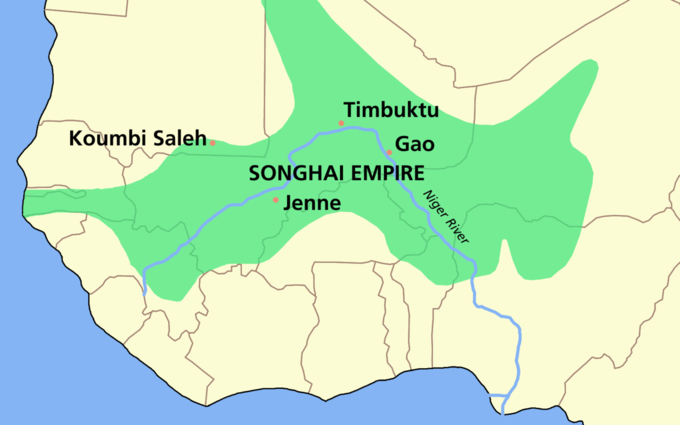
Songhai Empire in 1500: Songhai rulers took reward of the weakened Republic of mali Empire to expanded Songhai rule. Nether the rule of Sonni Ali, the Songhai surpassed the Malian Empire in expanse, wealth, and power, arresting vast areas of the Mali Empire and reaching its greatest extent.
Post-obit Ali's reign, Askia the Cracking strengthened the Songhai Empire and fabricated it the largest empire in Due west Africa's history. At its peak under his reign, the Songhai Empire encompassed the Hausa states as far as Kano (in present-day Nigeria) and much of the territory that had belonged to the Songhai empire in the due west. His policies resulted in a rapid expansion of merchandise with Europe and Asia, the cosmos of many schools, and the institution of Islam as an integral function of the empire. Askia opened religious schools, constructed mosques, and opened up his court to scholars and poets from throughout the Muslim world, but he was also tolerant of other religions and did not force Islam on his people. Among his great accomplishments was an interest in astronomical knowledge, which led to the evolution of astronomy and observatories in the capital.
Not only was he a patron of Islam but he was also gifted in administration and encouraging trade. He centralized the administration of the empire and established an efficient bureaucracy that was responsible for, among other things, tax collection and the administration of justice. He as well demanded that canals exist built in club to enhance agriculture, which would eventually increase merchandise. More importantly than anything he did for trade was the introduction of weights and measures and the appointment of an inspector for each of Songhai's important trading centers. During his reign Islam became more widely entrenched, trans-Saharan trade flourished, and the Saharan salt mines of Taghaza were brought within the boundaries of the empire.
However, as Askia the Peachy grew older, his power declined. In 1528, his sons revolted against him and declared Musa, one of Askia's many sons, as rex. Following Musa's overthrow in 1531, Songhai's empire went into reject. Multiple attempts at governing the empire past Askia's sons and grandsons failed and between the political chaos and multiple civil wars inside the empire, Morocco invaded Songhai. The main reason for the Moroccan invasion of Songhai was to seize control and revive the trans-Saharan trade in salt and gilt. The Songhai military machine, during Askia's reign, consisted of total-time soliders, merely the king never modernized his ground forces. The Empire fell to the Moroccans and their firearms in 1591.
The Organization of Songhai
At its peak, the Songhai city of Timbuktu became a thriving cultural and commercial centre where Arab, Italian, and Jewish merchants all gathered for trade. Economic trade existed throughout the empire due to the continuing ground forces stationed in the provinces. Central to the regional economy were independent gold fields. The Julla (merchants) would form partnerships, and the state would protect these merchants and the port cities of the Niger.
The Songhai economy was based on a clan system. The clan a person belonged to ultimately decided one's occupation. The near mutual were metalworkers, fishermen, and carpenters. Lower caste participants consisted of mostly non-subcontract working immigrants, who at times were provided special privileges and held high positions in society. At the top were noblemen and direct descendants of the original Songhai people, followed past freemen and traders. At the bottom were war captives and European slaves obligated to labor, especially in farming. Historian James Olson describes the labor system equally resembling modern day unions, with the empire possessing craft guilds that consisted of diverse mechanics and artisans
Criminal justice in Songhai was based mainly, if non entirely, on Islamic principles, especially during the dominion of Askia the Great. Upper classes in gild converted to Islam while lower classes ofttimes continued to follow traditional religions. Sermons emphasized obedience to the male monarch. Sonni Ali established a system of government nether the royal courtroom, afterwards to be expanded by Askia, which appointed governors and mayors to preside over local tributary states situated around the Niger valley. Local chiefs were still granted say-so over their respective domains as long as they did non undermine Songhai policy.
Tax was imposed onto peripheral chiefdoms and provinces to ensure the potency of Songhai, and in render these provinces were given virtually complete autonomy. Songhai rulers only intervened in the affairs of these neighboring states when a situation became volatile, ordinarily an isolated incident. Each town was represented by authorities officials, holding positions and responsibilities similar to today's central bureaucrats.
The Yoruba States
While Ile-Ife is considered to exist the spiritual homeland of the Yoruba people, numerous Yoruba states were eventually centralized within the modernistic Oyo Empire, which grew to become one of the largest African states.
Learning Objectives
Discuss the Yoruba states and their progression towards centralized government
Key Takeaways
Cardinal Points
- Yorubaland is the cultural region of the Yoruba people in W Africa. It spans the modern-day countries of Nigeria, Togo, and Benin. Its pre-modern history is based largely on oral traditions and legends. According to Yoruba religion, Oduduwa became the ancestor of the first divine rex of the Yoruba.
- By the 8th century, Ile-Ife was already a powerful Yoruba kingdom, one of the primeval in Africa southward of the Sahara-Sahel. Almost every Yoruba settlement traces its origin to princes of Ile-Ife. Every bit such, Ife can be regarded every bit the cultural and spiritual homeland of the Yoruba nation.
- Ile-Ife was a settlement of substantial size between the twelfth and 14th centuries, with houses featuring potsherd pavements. Information technology is known worldwide for its ancient and naturalistic statuary also as stone and terracotta sculptures, which reached their peak of artistic expression between 1200 and 1400.
- The mythical origins of the Oyo Empire lie with Oranyan, who fabricated Oyo his new kingdom and became the first oba with the championship of Alaafin of Oyo. The oral tradition holds that he left all his treasures in Ife and immune another king named Adimu to dominion there.
- Oyo had grown into a formidable inland power past the end of the 14th century, only it suffered armed services defeats at the hands of the Nupe led by Tsoede. During the 17th century, Oyo began a long stretch of growth, becoming a major empire. Information technology never encompassed all Yoruba speaking people, but it was the nigh populous kingdom in Yoruba history. The key to Yoruba rebuilding Oyo was a stronger military and a more centralized regime.
- In the 2nd one-half of the 18th century, dynastic intrigues, palace coups, and failed military campaigns began to weaken the Oyo Empire. It became a protectorate of Great United kingdom of great britain and northern ireland in 1888 before farther fragmenting into warring factions. The Oyo country ceased to exist every bit whatever sort of power in 1896.
Key Terms
- Oranyan: A Yoruba king from the kingdom of Ile-Ife; although last born, he was heir to Oduduwa. According to Yoruba history, he founded Oyo every bit its kickoff Alaafin at around the year 1300 and one of his children, Eweka I, went on to become the start Oba of the Benin Empire.
- Yorubaland: The cultural region of the Yoruba people in W Africa. It spans the mod-twenty-four hour period countries of Nigeria, Togo, and Benin, and covers a total land expanse of 142,114 foursquare kilometers. The geocultural space contains an estimated 55 million people, the overwhelming bulk of whom are ethnic Yorubas.
- Ile-Ife: An ancient Yoruba city in southwestern Nigeria (located in the nowadays-twenty-four hours Osun State) that turned into the showtime powerful Yoruba kingdom, ane of the earliest in Africa south of the Sahara-Sahel.
It is regarded as the cultural and spiritual homeland of the Yoruba nation. - Oduduwa: The King of Ile-Ife, whose proper name is mostly ascribed to the ancestral dynasties of Yorubaland considering he is held by the Yoruba to have been the ancestor of their numerous crowned kings. Following his posthumous deification, he was admitted to the Yoruba pantheon as an aspect of a primordial divinity of the same name.
Yorubaland: Introduction
Yorubaland is the cultural region of the Yoruba people in West Africa. It spans the modern-24-hour interval countries of Nigeria, Togo, and Republic of benin. Its pre-modern history is based largely on oral traditions and legends. According to Yoruba religion, Olodumare, the Supreme God, ordered Obatala to create the earth, but on Obatala's manner he establish palm wine, which he drank and became intoxicated. Therefore, his younger brother, Oduduwa, took the three items of creation from him, climbed downwardly from the heavens on a concatenation, and threw a scattering of earth on the primordial ocean, then put a cockerel on it and then that information technology would besprinkle the earth, thus creating the land on which Ile-Ife would be built. On account of his creation of the world, Oduduwa became the ancestor of the first divine male monarch of the Yoruba, while Obatala is believed to take created the first Yoruba people out of clay. The significant of the word "ife" in Yoruba is "expansion." "Ile-Ife" is therefore in reference to the myth of origin, "The Land of Expansion."
Ile-Ife
Evidence suggests that equally of the 7th century BCE, the African peoples who lived in Yorubaland were not initially known as the Yoruba, though they shared a common ethnicity and linguistic communication group. By the 8th century CE, Ile-Ife was already a powerful Yoruba kingdom, i of the earliest in Africa s of the Sahara-Sahel. Almost every Yoruba settlement traces its origin to princes of Ile-Ife. As such, Ife tin be regarded equally the cultural and spiritual homeland of the Yoruba nation. Archaeologically, the settlement at Ife can exist dated to the fourth century BC, with urban structures appearing in the twelfth century CE.
Until today, the Oòni (or king) of Ife claims direct descent from Oduduwa.
The city was a settlement of substantial size between the 12th and 14th centuries, with houses featuring potsherd pavements. Ile-Ife is known worldwide for its ancient and naturalistic bronze as well every bit stone and terracotta sculptures, which reached their height of creative expression between 1200 and 1400. In the menstruum around 1300 the artists at Ife developed a refined and naturalistic sculptural tradition in terracotta, rock, and copper alloy—copper, brass, and bronze—many of which announced to have been created under the patronage of King Obalufon II, the man who today is identified as the Yoruba patron deity of brass casting, weaving, and regalia. After this period, product declined as political and economic power shifted to the nearby kingdom of Republic of benin, which, like the Yoruba kingdom of Oyo, developed into a major empire.

Statuary caput from Ife, probably a king, dated around 1300
Ile-Ife is known worldwide for its aboriginal and naturalistic bronze, stone, and terracotta sculptures, which reached their peak of creative expression between 1200 and 1400.
The Rising of the Oyo Empire
The mythical origins of the Oyo Empire lie with Oranyan (also known as Oranmiyan), the second prince of Ile-Ife, who made Oyo his new kingdom and became the first oba with the title of Alaafin of Oyo (Alaafin means "owner of the palace" in Yoruba). The oral tradition holds that he left all his treasures in Ife and allowed another rex, named Adimu, to rule there.
Oranyan was succeeded by Oba Ajaka, but he was deposed because he immune his sub-chiefs too much independence. Leadership was and then conferred upon Ajaka'due south brother, Shango, who was later deified as the deity of thunder and lightning. Ajaka was restored after Shango's death. His successor, Kori, managed to conquer the rest of what afterwards historians would refer to as metropolitan Oyo. The heart of metropolitan Oyo was its majuscule at Oyo-Ile.
Oyo had grown into a formidable inland ability by the end of the 14th century, just it suffered armed services defeats at the hands of the Nupe led by Tsoede. Sometime around 1535, the Nupe occupied Oyo and forced its ruling dynasty to take refuge in the kingdom of Borgu.
The Yoruba of Oyo went through an interregnum of eighty years as an exiled dynasty. All the same, they re-established Oyo to be more centralized and expansive than e'er. During the 17th century, Oyo began a long stretch of growth, becoming a major empire. It never encompassed all Yoruba-speaking people, but it was the nearly populous kingdom in Yoruba history.

Oyo Empire and surrounding states c. 1700
The Oyo Empire rose through the outstanding organizational skills of the Yoruba, gaining wealth from trade and its powerful cavalry. Information technology was the virtually politically important state in the region from the mid-17th century to the late 18th century, belongings sway not just over most of the other kingdoms in Yorubaland, just also over nearby African states, notably the Fon Kingdom of Dahomey in the modernistic Republic of Benin to the west.
The Power Of Oyo
The key to Yoruba rebuilding Oyo was a stronger military and a more centralized government. Oba Ofinran succeeded in regaining Oyo's original territory from the Nupe. A new capital, Oyo-Igboho, was constructed, and the original became known every bit Quondam Oyo. The next oba, Eguguojo, conquered most all of Yorubaland. Despite a failed attempt to conquer the Benin Empire sometime between 1578 and 1608, Oyo continued to aggrandize. The Yoruba allowed autonomy to the southeast of metropolitan Oyo, where the non-Yoruba areas could human activity equally a buffer between Oyo and Imperial Benin. By the finish of the 16th century, the Ewe and Aja states of mod Republic of benin were paying tribute to Oyo.
The reinvigorated Oyo Empire began raiding southward as early equally 1682. By the cease of its war machine expansion, its borders would reach to the coast some 200 miles southwest of its capital. At the beginning, the people were concentrated in metropolitan Oyo. With imperial expansion, Oyo reorganized to amend manage its vast holdings within and outside Yorubaland. Information technology was divided into four layers defined by relation to the core of the empire. These layers were Metropolitan Oyo, southern Yorubaland, the Egbado Corridor, and Ajaland.
The Oyo Empire adult a highly sophisticated political structure to govern its territorial domains. Scholars have not determined how much of this structure existed prior to the Nupe invasion. Some of Oyo'southward institutions are clearly derivative of early accomplishments in Ife.
The Oyo Empire was not a hereditary monarchy, nor an absolute 1.
While the Alaafin of Oyo was supreme overlord of the people, he was not without checks on his power. The Oyo Mesi (seven councilors of the states) and the Yoruba Earth cult known as Ogboni kept the Oba's power in check. The Oyo Mesi spoke for the politicians while the Ogboni spoke for the people, backed by the power of religion. The power of the Alaafin of Oyo in relation to the Oyo Mesi and Ogboni depended on his personal character and political shrewdness.
Oyo became the southern emporium of the trans-Saharan trade. Exchanges were made in salt, leather, horses, kola nuts, ivory, cloth, and slaves. The Yoruba of metropolitan Oyo were also highly skilled in arts and crafts making and iron work. Aside from taxes on trade products coming in and out of the empire, Oyo also became wealthy off the taxes imposed on its tributaries. Oyo's imperial success fabricated Yoruba a lingua franca almost to the shores of the Volta. Toward the end of the 18th century, the empire acted every bit a go-betwixt for both the trans-Saharan and trans-Atlantic slave trade. By 1680, the Oyo Empire spanned over 150,000 square kilometers.
Decline
In the second half of the 18th century, dynastic intrigues, palace coups, and failed armed services campaigns began to weaken the Oyo Empire. Recurrent ability struggles and resulting periods of interregnum created a vacuum, in which the ability of regional commanders rose.
As Oyo tore itself autonomously via political intrigue, its vassals began taking reward of the state of affairs to printing for independence. Some of them succeeded, and Oyo never regained its prominence in the region. It became a protectorate of Nifty Great britain in 1888 earlier further fragmenting into warring factions. The Oyo land ceased to be equally any sort of ability in 1896.
0 Response to "How Did the Arts of the West African Empires"
Post a Comment